
Welcome to St Pyro! If you’re like me, you’re probably wondering who the heck St Pyro even is.
You see, back in my university days I was sitting in a class and the prof walked around, dropping handouts on our desks. The handouts were an excerpt from the writing of a French cleric named Guibert of Nogent. His work was called On the Saints and their Relics, and it was written around the year 1100.
Okay, cool.
I glanced down at the page and the name “St Pyro” leapt up at me. Now, I’d never heard of this saint before, and let’s be honest: Pyro is kind of a cool and unusual name. So I read through.
Now Guibert of Nogent was a pretty disapproving fellow. He didn’t like the way the worship of saints was happening at the time (an interesting discussion but well outside our scope here), but he especially didn’t like our St Pyro. He wrote:
“I have read – and even had to reread with utter loathing to those who happened to be with me – a story about a certain abbot who was called Saint Pyro in the story. When I enquired into the death of this man, whom I thought to be a saint on the basis of what I had read, I discovered the pinnacle of his sanctity, namely that he had drunk past the point of being sober, fallen down a well, and thus died.”1
Well, this was interesting! Now, this was back before the days of Google and the internet as we know it today, so I didn’t have the research resources that I do now. And so this is where it stayed: a sort of irreverant reference to a strange drunk “saint” mentioned in passing over 900 years ago. Neat, but not something I thought of very often.
When the time came to build this Armoury, however, I reached back into my memory, found the name, and realized that I really didn’t know anything about this cool-named Saint Pyro at all. Fortunately, I was able to find out lots more – and lo and behold! it turned out that St Pyro was the perfect saint for us!
As you know, referencing a saint in a business name was pretty normal in the Middle Ages. After all, you want someone to be looking out for you and your needs. And hey: Saint Pyro isn’t really all that busy, since there are no churches, schools, or universities named after him, and he’s not the patron saint of … anything at all. He’s not even an offical saint these days, so we get him all to ourselves.
The one catch is that we sell armour. And that’s not generally a very saintly practice. Hair shirts and prayer beads might be more the thing – but then it got even better.
We found out that St Pyro was the abbot of a monastery on a small island off the coast of Wales way back in the 500s. The very early days of European Christianity, and well after the end of the Roman empire in Britain. So he was already some 600 years in the past by the time Guibert of Nogent came across him.
St Pyro and his monks were a wild bunch by all accounts. Pyro founded the abbey himself, and he was the first abbot. After his drunken death he was succeeded by a real saint, St Samson of Dol. But Saint Samson abandoned the monastery in disgust at the uncontrolled behaviour of the monks there, so Pyro really left his mark.
More to the point, St Pyro was able to found an entire monastery because he was a nobleman. He lived in a castle that still exists and is now called Maenorbyr (Pyro’s Manor) after him. One of the few tangible remnants of Pyro’s life still surviving in this world.
And what does that mean? It means that our St Pyro had lived in a castle as a nobleman, and what did noblemen wear in the 500s (which was before knights even existed)?
Mail armour.
Yes, that’s right: our St Pyro actually owned and wore mail armour. For real.
And that is why he’s our personal patron saint, even if he’s not considered a real saint anymore. Something tells me that the wild abbot wouldn’t have let a small thing like that hold him back.
And because saints are always displayed with the instrument of their martyrdom, we chose a well – with a pair of feet just visible as the good abbot disappears to his reward.
So if you ever find yourself needing a mail shirt, St Pyro is here to help you.
And if you ever find that one night you’ve maybe partaken in a little too much cheer, may St Pyro himself guide your steps home safely.
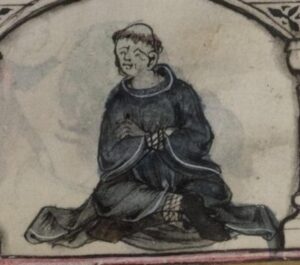
Title image from the collection of the British Library, BL Yates Thompson 13 (The Taymouth Hours), f.173
